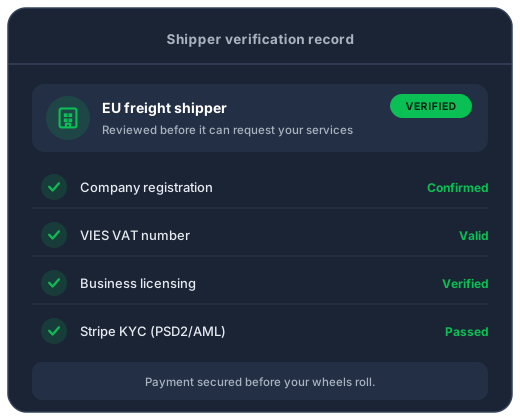
A CargoPay shipper is a verified company. You know who is requesting your services.
When you see a shipper registered on CargoPay, the due diligence has already been done. Every shipper passes a manual platform review and Stripe's customer verification before they can request your services. Their membership is a signal of legitimacy.
What the carrier is actually waiting for
European carriers face a structural cash flow challenge that constrains fleet growth, compels operators to decline profitable lanes from shippers they cannot verify.
Net 30–60 Post-POD payment terms
Standard terms in the sector run 30 to 60 days after proof of delivery, and late payment on top of that is common. Nothing compensates for the money tied up between dispatch and payment.
Cross-Border jurisdictional complexity
Chasing unpaid invoices across EU member states introduces jurisdictional complexity around payment enforcement and legal recourse particularly for SME carriers.
Declined lanes
Carriers decline profitable lanes from unverified shippers due to receivables risk losing revenue per truck across European corridors.
Cash pressure
Self-financing operations while awaiting payment creates unsustainable cash flow pressure particularly for SME carriers with limited reserves and fixed operational costs.
What a Shipper's CargoPay Membership tells you
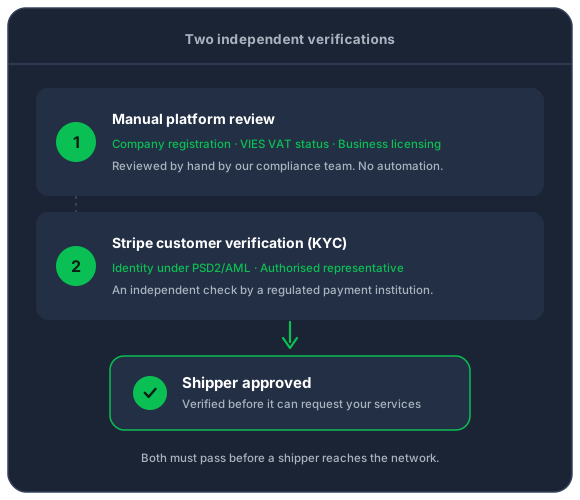
A shipper registered on CargoPay is a verified, legitimate business. Registration is not open it requires passing two independent verification processes:
-
Manual platform review
Our compliance team reviews company registration, VIES VAT status, business licensing, and operational credentials by hand. No automation, no shortcuts.
-
Stripe customer verification (KYC)
Identity verification under PSD2/AML financial regulation. Stripe independently confirms the business and its authorised representatives.
-
Authorised representative confirmed
The individual acting on behalf of the company has been identified and verified you know who you are dealing with.
How do you know a shipper is legitimate?
Before a shipper can request your services on CargoPay, they must pass a dual verification process that independently confirms their legal existence, operational legitimacy, and authorised representatives.
This is not self-declared. A shipper cannot simply create an account and start posting. Both CargoPay's compliance team and Stripe's financial verification infrastructure must independently approve the company before it gains any access to the network.
-
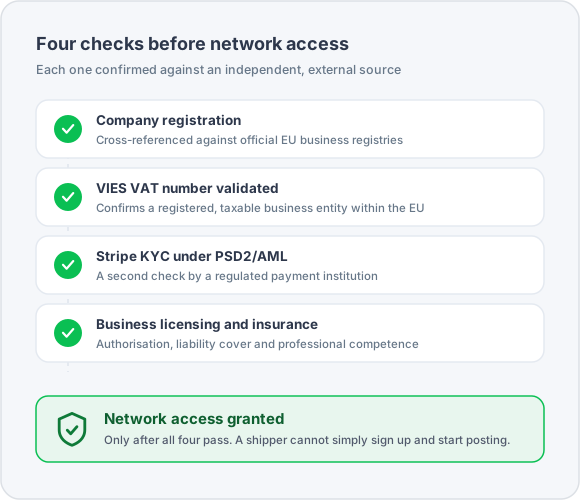
Company registration confirmed through official EU business registries
Not a self-reported claim cross-referenced against government databases.
-
VIES VAT number validated for EU cross-border compliance
Confirms the shipper is a registered, taxable business entity within the EU.
-
Stripe KYC under PSD2/AML financial regulation
A second, independent verification by Stripe a regulated payment institution confirming the business identity and its authorised signatories.
-
Business licensing and operational credentials verified
Business licensing, liability insurance, and professional competence confirmed before network access is granted.
CargoPay vs traditional credit insurance
Credit insurance is the traditional tool carriers use to protect against shipper non-payment. It is expensive, restrictive, and still leaves you exposed.
Traditional credit insurance
-
High annual premiums
A percentage of insured turnover, paid regardless of whether you have a claim. Costs scale with revenue penalising growth.
-
New customer exclusions
Most policies exclude new shippers for 90–180 days exactly when your risk of non-payment is highest.
-
Coverage caps and excess
Per-customer limits, policy excesses, and co-insurance clauses mean you still absorb a portion of every loss.
-
Reactive not preventive
Credit insurance pays out after a default. You still face months of collections effort, legal costs, and cash flow disruption.
CargoPay payment security
-
Transparent, per-transaction pricing
€799 + 1% per lane. You pay only when you transact. No annual premiums, no minimum commitments, no penalties for growth.
-
Every shipper verified before first engagement
No waiting period. Every shipper on CargoPay has passed full verification before they can request your services from day one.
-
Funds secured before dispatch
On the workflow the shipper selects, the money is authorised, captured or deposited before loading. There is no claim to file afterwards, because nothing was advanced on credit.
-
Preventive not reactive
The payment question is settled before the load moves rather than chased afterwards, which is where collections effort and legal costs come from.
Every transaction is analysed for fraud
Verification doesn't stop at onboarding. CargoPay analyses every payment request through a dual-layer risk engine combining Stripe Radar's machine-learning fraud detection with our own platform-specific anti-fraud scoring before any transaction is processed.
Stripe Radar
Machine-learning fraud scoring powered by Stripe's global payment network. Every transaction receives an independent risk assessment based on billions of data points from across Stripe.
Geographic & IP analysis
IP country vs. business country mismatch detection. High-risk country flags, VPN/proxy/Tor exit node identification, and datacenter IP pattern analysis.
Behavioral analytics
Historical transaction patterns analysed for each company timing anomalies, amount deviations, and velocity spikes flagged in real time across the last 100 transactions.
Reputation scoring
Five-dimension company reputation model verification depth, engagement history, account longevity, compliance status, and payment reliability continuously updated with every transaction.
Automated decision engine
Every risk assessment produces an automated decision: transactions scoring above the high-risk threshold are blocked in real time. Mid-range scores trigger manual review by our compliance team. Low-risk transactions proceed normally. The combined score weighs Stripe Radar at 40% and CargoPay's platform analysis at 60%, with reputation adjustments applied to companies with a track record.
Velocity controls & Alerting
Rate limiting on transaction creation, capture, and refund actions prevents coordinated fraud patterns. High-risk events trigger immediate alerts to our risk team for investigation before any funds move.
Pre-dispatch payment security
Whichever of the three workflows the shipper selects, the money is authorised, captured or deposited before dispatch rather than invoiced after POD. The choice is made per lane, and the whole transaction is documented and available for reconciliation.
Immediate payment
The full freight charge is captured when the load is accepted, so the funds are in place before dispatch and nothing is left outstanding while the shipment runs.
Authorisation & capture
Funds held at authorisation; released upon delivery confirmation. You have documented payment security without pre-payment complexity.
Deposit & balance
Partial advance at dispatch, balance on POD. Reduces working capital exposure on longer lanes while maintaining structured payment.
When a shipper is registered on CargoPay, you know
Their membership is not a listing. It is a documented, verified signal of legitimacy.
They are a verified, KYC-compliant legal entity
Company registration confirmed through official EU registries. VIES VAT number validated. Not an anonymous party.
Payment terms for the run are documented and enforceable
Who pays, when payment occurs, and under what conditions all documented, verifiable, and auditable within the platform.
Payment is secured per the selected workflow before dispatch
The money is captured, authorised or deposited before you commit services, driver hours or a fuel advance, so the payment date is known when you accept the load rather than after POD.
A complete, immutable audit trail exists
Full payment history within the platform for dispute resolution and financial reconciliation available when you need it.

A different trust environment across 27 EU Member States
Every participant in the CargoPay network both carriers and shippers has undergone the same dual verification process. This creates a fundamentally different trust environment than an open freight marketplace, where anonymous parties can engage without any credential checks.
When you accept a lane from a shipper on CargoPay, you are not relying on reputation or prior relationship. You are relying on a documented, verified signal that this is a legitimate business, with the payment terms written into the shipment before you load.
Register as CarrierKnow who you are loading for.
Work with verified
shippers.
Register your fleet and complete verification. When you accept a lane from a shipper on CargoPay, their membership is a signal that they are a verified, legitimate business across all 27 EU member states.