Deposit & balance
Staged freight payment engineered for long-haul operations. A mobilisation deposit funds fuel, tolls, and driver costs before dispatch. The balance is authorised at the same time, and you capture it once delivery is confirmed.
Use this workflowOperating costs accrue long before freight revenue arrives
Deposit & Balance acknowledges the fundamental cash flow reality of European road freight.
Diesel must be purchased at the pump. Tolls are due at every border crossing. Drivers require per diems and trip compensation. Waiting 45 to 60 days for a single post-delivery payment creates unsustainable cash pressure, particularly for the SME carriers that dominate the European road freight sector.
Deposit & Balance resolves this by front-loading operational capital while maintaining a clear balance payment tied to verified POD. Both carrier and shipper gain measurable commercial advantage.
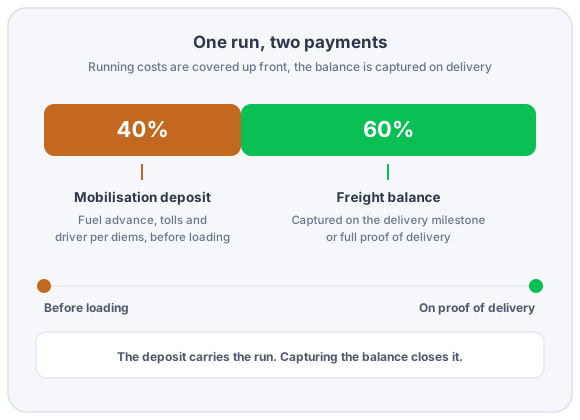
Mobilisation deposit
Covers fuel advance, tolls, driver per diems before loading
Freight balance
Paid on the delivery milestone or full POD confirmation
When to use deposit and balance
Engineered for operations with significant upfront costs and multi-stage delivery cycles.
Cross-border long-haul
Pan-European routes where diesel and toll costs are material. The deposit funds operating expenses; the balance pays upon verified POD at destination.
Multi-Leg & Cross-Dock operations
Complex lanes with multiple handling points, transhipment, or value-added services. Staged payment aligns with operational milestones.
New or scaling lane partnerships
Neither party comfortable with full prepayment, yet upfront capital commitment is essential to secure fleet capacity and driver allocation.
Cash for the run
Carrier requires pre-delivery capital without resorting to invoice factoring or expensive short-term fleet financing.
How deposit & balance executes
A structured, configurable two-stage payment that mirrors how road freight operations actually function.
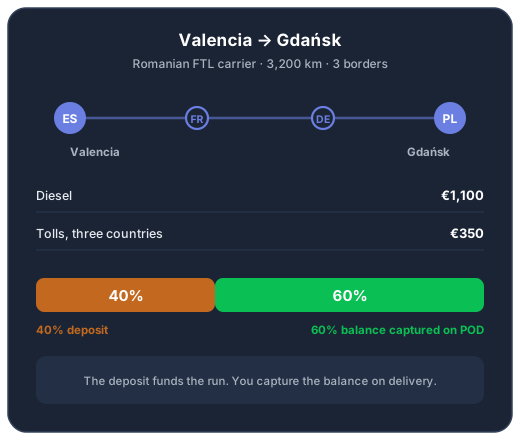
Cross-border long-haul with high running costs
A Romanian FTL carrier accepts a consignment from Valencia, Spain to Gdańsk, Poland a 3,200 km multi-day corridor crossing France, Germany, and Poland. Diesel costs alone exceed €1,100, and tolls across three countries add another €350.
The carrier cannot finance the entire lane while waiting 45 days for payment. Through CargoPay, the carrier structures a 40% mobilisation deposit upfront from the Spanish shipper.
40%
Deposit: fuel, tolls, driver per diem
60%
Balance: paid on Gdańsk POD
0 Days
Financing gap after delivery
What it means for your cash
Why this matters for European road freight
Most road transport operators in the EU are small businesses that typically depend on self-financed fleet operations. Cash flow constraints between dispatch and payment are the single largest barrier to fleet growth and driver retention.
A deposit paid up front covers the fuel and the driver at the start of the job, which is the part that would otherwise be funded by invoice factoring or short-term borrowing. The carrier runs the lane without carrying the shipment on its own money.
1%
CargoPay transaction feeImmediate
Mobilisation capitalA deposit at the start, the balance on delivery
Register with CargoPay and split the freight charge on the long-haul corridors where the start of the job has to be funded before anyone is paid in full.