Everything a load needs.
One network.
Find the load. Agree the price. Move it. Document it. Get paid.
CargoPay is a closed network of verified European shippers and carriers, where a load runs from first contact to final payment without leaving the platform. One record underneath all of it, so the same shipment is never typed twice.
One record, from first contact to final payment
Six stages on one shipment record, in the order you use them. The shipment comes first; everything after it is created from it.
Create
The shipment record
Post
Freight and truck boards
Agree
Quotations and bids
Dock
A named slot, not a queue
Document
eCMR, DeCA and eFTI
Get paid
Payment on agreed terms
Take the whole chain, or start anywhere on it
Each part works on its own. Together they stop the retyping.
Shipment management
The record everything else derives from. You create it once, then post it to the boards or open it for bids, and the documents, the dock slot and the payment are all generated from it.
How it connectsTransport documents
eCMR for international movements, DeCA and eFTI for Spain. Built from shipment data you already hold, so compliance costs no extra work and cannot contradict the order.
Explore documentsDockPass
Your loading bays as a bookable calendar. Carriers book their own slot against the shipment, with no account, and the yard runs the day from one board.
Explore DockPassPayments
You pay the carrier on their terms and wait on your customer for theirs. Authorisation windows and deposit-and-balance workflows fix both dates on the shipment before it is dispatched.
Explore paymentsAll of it between companies that passed the same verification before they reached the network.
Trusted infrastructure
A load lives in eight systems and belongs to none of them
A board to find the truck. Email and messaging to agree the rate. A spreadsheet for the shipment. Paper for the CMR. A phone call for the dock. Accounting for the invoice, and a factor when it comes back late. Each one retypes the same load, and none of them can prove what the other agreed.
That fragmentation is what causes everything else. Payment terms stretch because nobody can show what was promised. Criminal networks impersonate legitimate carriers because a board only knows an email address. The load itself is the one thing none of those systems holds.
Terms nobody can prove
What was agreed lives in an inbox, so what is owed is a matter of recollection.Companies nobody checked
A board entry is an email address. It is not evidence that a company exists.The same load, retyped
Every system holds its own copy, and the copies disagree at exactly the wrong moment.Cash tied up in waiting
You pay the carrier on their terms and wait on your customer for theirs. The difference comes out of your own working capital.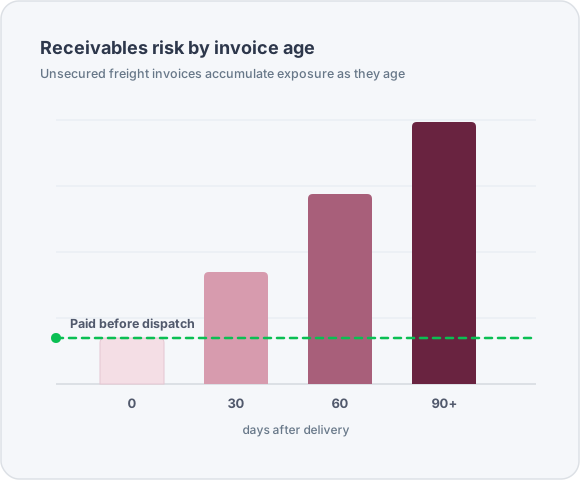
Follow one load through the platform
Every step writes to the same record, which is why no step starts by retyping the last one.
Post or find
A shipper posts freight, or a carrier publishes a truck. Everyone looking is a company that already cleared verification.
Bid and award
Carriers bid, the shipper awards one. The award lands on the shipment that was already there, so the agreed rate and terms are on the record from that moment.
The shipment exists
Parties, route, cargo, equipment and dates, entered once. Everything after this reads from it rather than asking again.
Documents generate
The eCMR and the DeCA or eFTI document are built from the shipment. No second data entry, and nothing to reconcile at the roadside.
The dock is booked
The slot is reserved against the shipment, so the driver arrives to a named time on a named bay instead of joining a queue.
The money lands
On the terms fixed before dispatch. Because the platform can see the load actually moved, payment is tied to evidence rather than to somebody's word.
Three things that only work because the others exist
This is the part a board with a payment button bolted on cannot reproduce.
Compliance is free
Because the document is a byproduct of execution. On its own, an eCMR product is one more system to keep in sync with the order.
Payment follows the record
Because the platform knows the load moved, from the status, the dock arrival and the signed CMR. A payment tool with no operational record has to take your word for it.
Reputation means something
Because it is anchored to a verified identity and computed from what actually happened, not from stars a stranger clicked.
CargoPay by the numbers
What the platform is, in four figures.
1%
per transaction, all-in, no hidden fees
27
EU member states supported
0
hidden fees, subscriptions, or minimums
3
payment workflows, chosen per shipment
Stop running one load through eight systems
Register your company and join a network where every company has already been verified. One registration, one fee, the whole chain.
I'm a carrier
Know who is paying and on what terms before you turn a wheel, and arrive to a booked slot instead of a queue.
- Payment agreed before loading
- Access to verified EU shippers
- Documents on the phone, not on paper
I'm a shipper
Award a load to a carrier you never have to vet again, and get the transport document the moment the load exists.
- Access to verified EU carriers
- Compliant documents by default
- Reduce your fraud exposure
Simple, transparent pricing:
Nobody signs up. Companies are admitted
Verification is not a badge worn by some members. It is the condition of being here at all.
Documents reviewed
Registration documents, credentials and insurance are read by a person before a company is approved.
VAT and address checked
VAT numbers are confirmed against the EU registry, and the trading address is scored against what the company claims.
Stripe verification
Every company completes Stripe's business verification. Payment data never touches CargoPay servers.
Conduct on the record
What a company does here builds a reputation that follows it, because it is tied to an identity that was proven.